The Door Handle as a Tiny Instruction
Door handle design can signal whether to pull, push, turn or slide before anyone reads a sign, making entrances easier to understand at a glance.
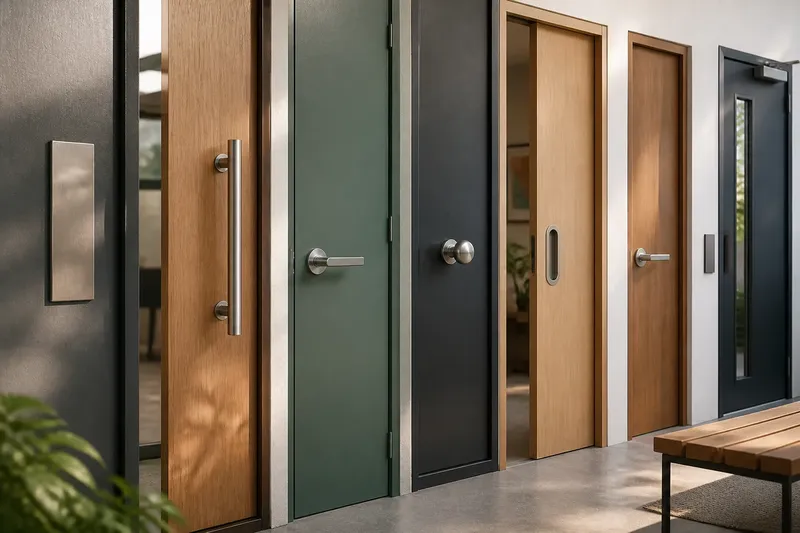
Should you push, pull, turn or slide? A door handle can answer before you reach for a label. Its shape, position and resistance form a small physical instruction, helping people choose an action through touch and sight. That instruction works best when the handle’s appearance and movement agree.
Here are seven familiar handle forms and the cues each one gives. The same cue can mean different things in different settings, so consider the door, the approach and the people expected to use it together.
1. A flat plate suggests a push
A broad, flat plate gives the palm a clear place to land. It offers little reason to curl the fingers around it, so the hand naturally presses forward. On a door intended to open by pushing, that is a direct and legible cue.
The plate’s position matters. Place it where an approaching hand can meet it comfortably, rather than making someone search near the edge or reach across their body. A plate set on the wrong side can still look inviting, but the door’s movement will contradict the invitation.
Think about the surface as well as its outline. A smooth panel may suit a clean push, while a small raised area can help identify the contact point. Avoid adding a grip-like shape to a surface meant only for pushing; it may prompt a pull instead.
2. A projecting bar invites a pull
A bar that stands away from the door gives the fingers room to pass behind it. That space communicates grasping, and the hand can draw the door towards the body. A horizontal bar is especially easy to recognise as something to hold.
Projection needs to be considered alongside the route through the doorway. A bar that catches bags, sleeves or passing hands can make an otherwise clear instruction awkward. A compact pull may be a better fit where people pass close to the door, provided there remains enough space to grip it comfortably.
Direction can be unclear if similar bars appear on both sides of a door that swings one way. The intended action should be reinforced by the position of the handle and the door’s movement, rather than left to guesswork. If the door must be pulled, a flat push plate on the opposite face helps distinguish the two sides.
3. A lever asks for a downward press
A lever handle can be operated by pushing it down. Its long arm offers leverage, while its pivot gives the hand a visible point of movement. Unlike a knob, it does not ask the user to grip and twist the whole fitting.
That movement can be useful when a person’s hands are occupied or their grip is limited. The end of the lever should not be so short or cramped that the fingers have nowhere to rest. A shape with a clear, accessible underside makes the pressing action easier to read through touch.
Lever direction also carries information. If the arm points towards the edge of the door, the user can see where pressure will land and how the fitting is likely to move. Decorative twists, sharp angles or an unusually heavy-looking form may make the action less obvious without adding useful guidance.
4. A round knob signals a turn
A round knob is most strongly associated with grasping and rotating. Its continuous surface offers no obvious pressing edge, so a twisting action is the natural guess. The form can be compact, but it depends on the user being able to close a hand around it.
A smooth spherical knob can be harder to turn than a shaped one, particularly for someone whose grip is less secure. A slightly textured surface or a form with subtle flats may offer a clearer hold. These changes should help the hand engage without making the knob look like a lever.
Use the surrounding door to clarify whether the knob is a latch control or simply a pull. If the door opens by pulling after the knob turns, the fitting carries two separate instructions. A nearby pull or push cue can make the opening action clearer, especially where unfamiliar visitors are likely to approach.
5. A recessed cup suggests sliding
A shallow cup set into a door gives the fingertips somewhere to hook, but it does not project into the room. This form often suits a sliding door because it can be grasped without blocking the panel’s path. The hand pulls sideways, and the door follows along its track.
Make the cup large enough to find and use, with a rim that is easy to feel. A very small recess can look like a decorative detail rather than a grip. Its location should also make sense: placing it close to the door’s edge gives the hand a useful point from which to move the panel.
A flush fitting can be discreet, but discretion is not the only aim. If the recess disappears against the door surface, a visitor may push the panel or search for another handle. A change in texture, finish or surrounding shape can mark the grip without turning it into a visual distraction.
6. A handle at the edge tells the hand where to start
Position is part of the instruction. A handle near the opening edge gives the user a natural place to act and leaves room for the door to swing. A fitting placed near the hinges can invite an awkward reach and provide less leverage for moving the panel.
The approach matters too. If a door sits in a narrow corridor, consider which hand is likely to reach it and whether the handle is easy to access without stepping into another person’s path. In a pair of doors, consistent handle placement can help people recognise the intended route instead of trying both leaves.
Imagine a small meeting room with a plain door and a lever mounted near its opening edge. If the room side is meant to be pushed, a broad plate on that face gives an approaching visitor a place to press; a pull fitting on the corridor side supports the reverse action. The expected observable result is that the two faces communicate different movements without relying on a sign.
7. Resistance confirms or contradicts the cue
Shape starts the instruction; resistance completes it. A handle that moves freely and a door that responds smoothly make the expected action feel confirmed. If the lever is stiff, the knob spins without releasing the latch, or the door barely shifts after a push, the physical message becomes uncertain.
Resistance should be considered in relation to the user, not just the fitting. A heavy door can demand more effort than its handle suggests. Where a closer or latch is involved, the door should still feel manageable for the people expected to use it. For adjustments affecting fire doors, access requirements or other safety matters, follow the manufacturer’s instructions and local rules or ask a qualified professional.
Do not add extra labels to compensate for every small difference in feel. First check whether the handle’s form, position and movement tell the same story. A sign can help where an action is unusual, but it is not a substitute for a fitting that communicates clearly.
How can you tell what a handle is asking you to do?
What does a flat plate mean?
A broad plate usually offers a place to press with the palm, so it tends to signal pushing. Check which way the door moves from that side; the cue should agree with the movement.
Why do some doors have a plate on one side and a bar on the other?
The plate can indicate pushing, while the projecting bar offers a place to grasp and pull. Using distinct forms on opposite faces helps explain the door’s action without extra wording.
Does a lever always mean the door opens by pushing?
No. A lever commonly signals that the latch should be pressed down, but the door itself may then need pushing or pulling. Look at the fitting’s position and the way the door responds.
What should you change if people hesitate at a door?
Notice where they reach and whether they push, pull or twist before the door moves. Then consider whether the shape, location or resistance is giving a conflicting cue, and address the cause rather than adding decoration.
Match the fitting to the action
When choosing a handle, start with the movement the door needs: push, pull, turn or slide. Then ask whether the form gives the hand a suitable contact point, whether its position is easy to reach and whether its resistance feels consistent with the action. These questions make door handle design easier to assess in a home, workplace or public entrance.
What is not worth the effort is selecting a striking handle first and trying to make its shape explain a movement it does not support. A restrained fitting with a clear grip and a straightforward action is often easier to understand. Check the door from both sides, and let each side show the user what to do next.