A Reading Corner in a Shared Room Without Adding Furniture
A reading corner in a shared room can feel distinct without extra furniture: use chair orientation, sightlines and existing boundaries to mark a quiet place.
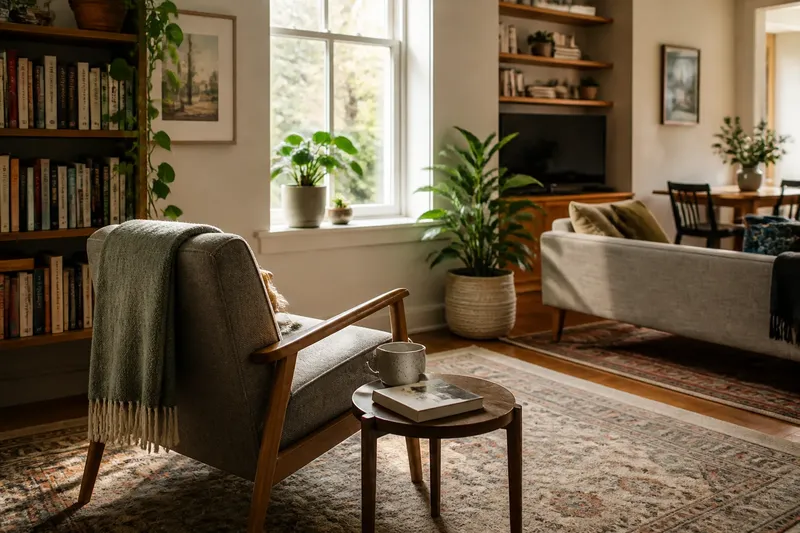
Where can you read in a shared room without moving in another chair or screen? A reading corner in a shared room can come from turning an existing seat towards a calmer view and using the room’s current edges to give it a sense of place. The aim is not to block other people out. It is to make one spot feel set aside while keeping the room useful to everyone.
Choose the boundary your room already offers
Start by noticing what is already shaping the room: a sofa back, a bookcase, a window recess, a rug edge or the gap between a table and a wall. These features can act as visual boundaries. A boundary need not surround the chair; often, one clear edge is enough to distinguish a reading spot from the main path through the room.
Then consider what the reader sees while seated. A view of a doorway, television or busy work surface can keep the room’s activity in the foreground. Turning towards a plain wall, window or plant can reduce that visual pull without changing the room itself. Keep the seat’s back clear of doorways and the main route, so the reading spot does not feel exposed or obstructive.
Try the arrangement while the room is in use. Sit in the chosen place as someone walks through or uses the sofa. If the chair interrupts movement or forces another person to squeeze past, adjust its angle or choose a different boundary. The room has to work for the people sharing it, not just look composed from the entrance.
Angle a chair for a clear sense of retreat
Turning an existing armchair or dining chair is the simplest approach when the room already has a suitable seat. A chair facing slightly away from the centre of activity signals a separate purpose. It can still remain open to conversation; the change in direction merely puts reading ahead of watching or socialising.
This option suits a room where the reader wants a quiet visual focus but needs to stay aware of others. It also works well when furniture cannot be shifted far. Check whether the seat’s current light is comfortable at the time you usually read. Daylight from a nearby window may help, but a direct view of a television or frequently used doorway may undo the sense of retreat.
Imagine you share a lounge where the only spare seat is beside the sofa. Turn that chair towards the window and slightly away from the television, leaving the route from the door to the sofa open. The expected result is a seat with a calmer view that still belongs to the shared room, rather than a new zone that cuts across it.
Do not angle the chair so sharply that it feels like a barrier or makes it awkward to join a conversation. A small change in orientation is often more legible than a dramatic turn. What matters is the relationship between the chair, its view and the room’s main activity.
Use a rug or furniture edge as a quiet frame
A rug can define a reading area without adding an object, if one is already in the room. Place the chair so it relates to the rug’s edge rather than floating beyond it. The rug then reads as a shared surface with a smaller, quieter use at one side. A sofa back or the end of a bookcase can do similar work by giving the chair a boundary behind or beside it.
This approach suits rooms where the seat cannot face away from activity, or where several people use the same open area for different things. The boundary gives the reading place a visual address, while the open side keeps it connected to the rest of the room. Avoid treating every edge as a divider: too many visual borders can make a shared space feel chopped up.
Use the existing furniture’s shape as a guide. A low sofa back may separate the chair from a play area without hiding the reader. A bookcase can make a stronger edge, but the chair should not obstruct access to shelves or turn a passage into a dead end. If the room has no rug or clear furniture edge, do not buy one just to create a corner; orientation may be enough.
Let a threshold do the separating
Some rooms have a natural transition, such as the area beside a window, an alcove or the end of a long room. Placing a reading seat near that threshold gives it a distinct position without closing it off. The change from one activity to another becomes apparent through location: the main seating remains in the centre, while reading occupies the quieter edge.
This works best when the threshold is not also a busy route or storage pinch point. A window recess may offer a restful view but feel uncomfortable if people pass close behind the reader. A corner near a doorway may appear secluded yet leave the seated person facing traffic. Judge the spot from the chair, not only from across the room.
Where no natural threshold exists, do not force one with improvised screens or stacks of objects. A clear orientation change is usually easier to live with and simpler to reverse when the room’s needs change.
Which reading-corner approach fits your room?
What if the room has no spare armchair?
Try an existing dining chair or the end of a sofa, then turn it towards a less active view. Choose a seat that remains comfortable for the length of reading you have in mind; a visually neat position is not useful if the posture quickly becomes tiring.
Can a reading corner stay part of a shared lounge?
Yes. Keep an open side towards the room and avoid placing the chair across the main walking route. The spot can feel quieter through its orientation without signalling that others must stay away.
Should the chair face a window or a wall?
Choose the view that feels calmer and gives you suitable light for the time you read. A window can offer depth and daylight, while a plain wall may reduce visual distractions; either can work if glare or activity outside is not bothersome.
How do I choose between orientation, a furniture edge and a threshold?
Use orientation when you have a suitable seat and want the lightest change. Use a rug or furniture edge when the open room needs a visible boundary, and choose a threshold when a naturally quieter edge is already available.
Choose by the room’s busiest route
Before settling on a layout, trace the route people use most often: from the door to the sofa, between the kitchen and table, or through the room to another space. The best reading corner sits outside that route while retaining a view that feels comfortable to the person in the chair. If the paths and the quietest view point in different directions, favour clear movement and make the chair’s orientation do more of the work.
There is little value in shifting every piece of furniture, buying a divider or trying to make the corner look like a separate room. Start with the seat you have, test one angle, and notice whether the room still flows for everyone. For a reading corner in a shared room, a useful boundary is the one that makes the quieter choice obvious without making the rest of the room harder to use.